Thursday, June 6, 2013

truth v. Truth


The goal of any scientist is to discover something that was once unknown. Research is the quest to understand nature a bit more than we had before, to find a new tidbit of truth that was once only a question. 

I believe that science does provide truth, but it does not provide the ultimate Truth. To quote Francis S. Collins on his experience of scientific discovery, 

“Having perceived a glimmer of scientific truth, I find at once both a sense of satisfaction and a longing to understand some even greater Truth. In such a moment, science becomes more than a process of discovery. It transports the scientist into an experience that defies a completely naturalistic explanation” 

This captures the universal desire that I believe everyone experiences - a desire for more than just the material of this world. A sense that there is something more, something above, something greater. This existential yearning is woven into the human psyche.  

I find that there is a constant, though sometimes unstated, argument between science and religion. There seems to be a misunderstanding that only one, science or religion, can be truth. But that is not the case. There is a distinction between truth and Truth.

Science provides a naturalistic truth. The truth of science comes from observable, testable and verifiable information. It strives to find the truth within the swarm of possible hypotheses to explain a certain phenomenon. These truths can then be applied in new ways to develop new technology, medicine, or theories. From these truths, our society has been propelled. From these truths, we learn about our environment. Ultimately, science’s quest is for truth - natural truth.

Religion, on the other hand, provides a supernatural Truth. When naturalistic explanations cease to satisfy, religion provides. In John 14:16 Jesus claims “I am the way the Truth and the life. No one comes to the father except through me.” Religion provides a greater purpose for this world - salvation, redemption, hope, love. Jesus, being beyond the natural realm, is the only provider of this kind of Truth. From these Truths we develop morality, purpose and our reason for existence. From these truths, we learn about our souls. Religion is the pursuit of truth beyond this world. 

Therefore, there is no reason that both science and religion cannot be purveyors of truth. I sometimes feel there is a distrust of science by the religious community, and those feelings are often returned by science unto religion. Both sides feel they are the only providers of truth. There does not need to be this “king of the hill” conflict. Science and religion are working towards different truths, and therefore cannot be compared. This conflict is found in no greater controversy than Evolutionary Theory… but we’ll get into that later. :) 

As Collins says in his quote, I believe that scientific truth can be a vessel into a religious Truth. Understanding the complexities of this world beckon for a greater presence. The intricacies of this universe are too dynamic to be purposeless. As I study science, I cannot help but worship its creator, and thank him for giving me the capacity to understand it all. I imagine God watching us with a smirk on his face as we tire endlessly to understand that which he created so effortlessly. I hope that one day, I will be able to claim a discovery - and one that propels his kingdom forward. 


Wednesday, June 5, 2013

The Language of God: An Introduction


I’ve been working my way through Francis S. Collins book The Language of God: A Scientist Presents Evidence for Belief. About to embark into graduate school, I thought it would be a good read. So far, that has proven true. So, I thought I might blog through some of my thoughts. This will hopefully be both a way to be entertaining and thought-provoking to others as well as a form of processing what I’m reading and developing my own ideas and beliefs. 

A brief background to the book so you’re not completely lost: Francis S. Collins was the director of the Human Genome Project and an atheist-turned-Christian. He came to faith through his own investigation and questioning. The book is his thoughts on his experience, faith and beliefs as a well-established and respected scientist who also believes in God. 

Part One of his book explores “The Chasm Between Science and Faith.” He narrates his investigation into Christianity that ultimately lead him to find faith. He tackles the biggest dilemmas and questions many seekers fight when they begin to seek God - especially as a scientist. I don’t want to bore you with a summary of them...I want to get some of my own thoughts out here.

In his introduction, he says something which sums up what I feel as a devoted Christian and scientist. He says,

“God’s domain is in the spiritual world, a realm not possible to explore with the tools and language of science. It must be examined with the heart, the mind and the soul- and the mind must find a way to embrace both realms”

God exists beyond and above science. He is greater than our test tubes and pipettes. He speaks to the soul and moves in the heart. Just look at the scriptures - the delight, joy and truth found the Bible could never compare to the facts outlined in a textbook. His realm is his own. 

Yet, this is his Kingdom and his creation. I can find joy in reading a science book similar to the joy in reading the scriptures - both are revealing his character and power. As an investigator of nature, I cannot help but see God’s magnificence in his creation. His provision is evident in the mechanisms, systems and relationships that sustain nature.

To think science can be used to disprove God is a fallacy. For God and science do not exist in the same realm. Nor can science be used to prove God. Can there be traces of God’s goodness within creation? Yes. Can science be used to explore these bits of evidence? Yes. Can science be used to ultimately prove God? No. But isn’t that where faith comes in? We are meant to embrace both the supernatural and the natural, but the way we do so is different for both.

I believe that God can move in the heart in a way no amount of natural facts ever could. I believe that God has given us minds to explore, investigate and understand his world and therefore those that are gifted to do so, must. 

Therefore, I am aware that God has gifted me to enjoy and thrive in science. I hope to use the skills he has given me to understand his creation and, in doing so, work to bring his Kingdom to earth. 


Tuesday, February 26, 2013

A Christian Ecological Movement


I was never aware of the biblical call to care for the environment. I knew that we were given "dominion" over creation, and that was always taught to me to mean we were to be responsible guardians. While that is essentially true, I was not aware how deeply the call for ecological responsibility resides within scripture. It is an intensely woven theme throughout scripture and one that has caught my attention. I try to live my life based upon the truths that are laid out in the Bible, but have not been aware of this particular call until now. It has been another, very convicting, development in my faith. Not only is it a moral obligation to care for the environment because it affects the quality of life for all of humanity, but ecological responsibility is also a God-given command for all his followers. If I am to hold scripture as my standard of truth, I must understand all the God calls me to do as his follower. Most Christians, I expect, are naive to these commands within scripture. If more Christians were aware of these truths, I think it could inspire a movement towards a more environmentally aware faith. Now, as I consider my actions, and the actions in my future, I attempt to align them with scripture. For example, when I think about living on my own next year, I realize that I will have to make decisions that reflect how I care for God’s earth. I will have full control over what food I buy, my methods of transportation, how I choose to live. After gaining a full understanding of how God calls us to live, I am excited to make those decisions in a way that reflects God’s will for his creation. I think it could be a major way to witness not only to anyone I may meet, but also to people I am close with, such as my family. It is not common to hear someone claim ecological responsibility in the name of Christ, but I believe it could make a serious impact in today’s society. 


Christians must begin to seriously question their actions towards the environment. I know that I have been personally convicted by my exposure to the ecological crisis and how my faith should coincide with the environment. Although always conscious about the environment, I was never motivated by faith to treat the earth well. It was always superficial. This has changed. I have become increasingly inspired by the truth and commands of scripture to care for the earth. I no longer see caring for the environment as merely human kindness towards the earth, but as a Christian responsibility. There needs to be a greater Christian movement towards widespread ecological responsibility. Humans, in general, do not like to take the blame for anything, so it makes sense that many people refuse to accept the cause and effect relationship between our actions and the current state of the Earth. If only we could overcome our greed, our overconsumption, need for power and our ignorant tyranny over creation and accept the problem and begin to rectify the situation. What better source of reconciliation than a group of people who follow a God who cares for the poor and cautions against greed, a God of justice, unity and harmony, a God who created all things and is supreme above all things? Christianity is perfectly positioned to begin a radical campaign for the environment. Its teachings provide remedies for our ecological crimes. Often times, environmentally aware living is associated with the “hippie” stereotype. How radical would it be if it could become synonymous with Christianity? The core beliefs of our faith are ripe to allow this kind of change, we only need to fight against the ignorance and misunderstandings that pervade the Christian faith in regards to the environment and begin to see creation in the same light as it’s Creator.

Tuesday, February 5, 2013

Are Christians to Blame?


Another reflection from Environmental theology (yes, this was an assignment. I hope it's good, I haven't gotten it back yet...). It's a little lengthy, sorry. Also, the books I mention are cited at the bottom of the page. The last three paragraphs, which I have bolded, are the one's I find to be most important. So if you're interested... maybe just skip down to those. 

This is Our Father’s World
Humanity is in the midst of an environmental crisis. While the crisis is universal, and logically must be due to the cumulative actions of the entire human population, direct attacks have been made against the Christian community as the cause of environmental degradation, disregard and disenfranchisement. The argument attempts to find validity in scripture, yet often relies on weak interpretation and incongruent behavior within Christianity. Most of their conclusions prove to be flawed and often point to fundamental weaknesses of all humankind, regardless of religious affiliation. The ecological complaint against Christianity is multi-fold but most advocates centralize their argument on anthropocentrism encouraged by the Christian faith. This human-centric belief is fed by an accused spiritual-material dualism and annihilisitic eschatological claims. Critics claim these aspects of Christianity are rooted in scripture. While the central arguments of Christian culpability are weak upon complete analysis, there are strings of true fault woven within Christian behaviors, past and present. Therefore, Christians must begin to analyze their actions towards the environment and how they align with core teachings of scripture.

According to critics, the anthropocentric tendencies of Christianity have caused complete devaluation of the environment. They claim Christianity holds the belief everything was created by God for the good of man. Everything created has a purpose, and that purpose it to be harnessed by man by any means. Christians, apparently, believe nature has no value outside of its benefit to humankind.  Therefore, Christians assume they have God-ordained authority to exploit the ecosystem. Often cited is Genesis 1:26 where humans are divinely granted “dominion” over all creation. This, however, is where the argument begins to find its weakness. If critics claim the Bible is directing Christians to be tyrants over God’s creation, they must ignore the rest of the Bible which clearly instructs harmony with nature. Even throughout the rest of Genesis, such as Genesis 2:7 which speaks of service to the earth, there are multiple examples which attest to the oneness of humans and creation. The Bible frequently teaches the requirements of human servitude towards the earth, as in Genesis 2:5. Steven Bouma-Prediger relates all these passages and declares humans to be “both responsible persons and earthy creatures” and therefore must exhibit both leadership and companionship with the earth (64).  Therefore, it is not a Christian tenet to believe humans are supreme, that role is reserved for God. 

This complaint can be linked to the drastic influence culture and human nature can have on the behavior of a religion, regardless of the beliefs outlined in their scriptures. It is the ethos of modern society which leads to a universal anthropocentrism of all humans. Society is largely focused on human progress, success and prestige. Christianity does not teach selfishness, instead it teaches selflessness. The selfish manifestation of Christianity is due to instinctive, albeit sinful,   human nature and the invading influence of secular culture. James A. Nash discusses this widespread human limitation claiming “the near universality of ecological problems suggests that the roots of the crisis are not in theological affirmations themselves, but rather in human character” and therefore should not be pinned on one particular religious group (Nash 89). Instead, all of humanity should analyze their selfishness in relation to how they treat the environment and they way they use, or abuse, its resources. Anthropocentrism, unfortunately, seems to be innate in human character and therefore society must carefully monitor their actions to insure they align with values such as sustainability, care, and respect for the environment. Christians, in particular, should be aware of the ecological manifestation of selfishness, which may otherwise go unnoticed against more blaring, traditional sins.

The elevation of humanity in the Christian faith, critics claim, is fueled by an encompassing dualism separating the material and the spiritual worlds. According to these analysts, Christianity places an emphasis on the spiritual realm, the individual soul and personal religion. Therefore, humankind has a reason to ignore the material creation while focusing on the spiritual priorities.  Apparently, in the Christian faith, God only cares about the salvation of the human soul and not about his creation, in which humanity dwells. Bouma-Prediger summarizes the claim that “Christianity fosters a care-less attitude toward matter and the body and thus is at fault for plundering the earth” due to the priority placed on spiritual salvation over the material world (60). According to the Biblical interpretation of these critics, this dualism is further supported by the eschatology prophesied in the holy scriptures. They infer the eschatology from the Bible consists of a complete destruction of the world in the processes of saving human souls. This prophecy, according to the critics, has fostered an attitude of disregard for the material aspects of this world. Since one day the world will be destroyed, it is a waste to care for creation today. Spiritual health should be prioritized above creation’s health. Christians, therefore, have no regard for nature since it will not be redeemed in end times. 

However, upon accurate analysis of the scriptures, this dualism and eschatological exhibition are not found. Instead, God is shown to care deeply for all members of his creation, not just the spirits of humans. Humanity itself is deeply rooted in creation and, therefore, there can be no separation between humans and creation. They are fundamentally one. God can show no favor for one over the other. The scriptures are also riddled with evidence of God’s care for the material creation. In Psalm 24, the psalmist sings “The earth is the Lord’s and all that is in it, the world, and those who live in it.” Clearly, this Psalm claims everything that is in the earth belongs to the Lord and therefore he must care for its whole. Those who live in the world, namely humans, are even listed secondary to the world itself. He will redeem the world in its entirety, not just human souls. Bouma-Prediger counters the annihilationist interpretation of redemption with the biblical claim that redemption will be a discovery of a new earth, a renewal of creation (69). In 1 Thessalonians 4:16 it shows God is going to descend upon the earth, not merely rescuing his people. He wishes to return to his creation. God will remain loyal to his original creation and does not want to see it destroyed. No artist would willingly burn their masterpiece after they completed it. Neither will God destroy his sole creation. He longs for it to flourish. Therefore, salvation will not entail a complete destruction, but instead redemption of the current creation. A correct interpretation of the Christian faith will find no separation between the spiritual and material, but instead a harmonious and inseparable relationship.

However, this is not to say these flawed beliefs are absent from the Christian Church. Clearly, there must be some behavioral evidence on which the critics base their assumptions. Often, Christians fall into the conclusion God cares more about the spiritual salvation and condition of our souls than for the material well-being of his creation. For example, most Christians place ministry-related jobs on a higher podium than secular careers. Even the adjectives “religious” and “secular” are evidence of Christian dualism, even though there is no scriptural basis for these segregations. Therefore, Christians must be aware of this dualism and prevent it from separating ourselves from God and from his creation. 

Although the accusations of Christian ecological critics often fall short of scriptural and theological truth, they are cause for a pause and reanalysis of Christian behavior towards the environment. In truth, they present a drastic need for repentance and reevaluation of the Christian response to the environment. Humans are members of God’s creation and therefore are called upon to be responsible and active participants in the care and advocacy of the environment. Nash admits the Christian negligence of ecological devastation when he admits “Christianity has done too little to discourage and too much to encourage the exploitation of nature” and suggests a widespread repentance from members of the Christian faith (74). This repentance is extremely warranted. 

Christianity’s ecological sins are two fold, as Nash explains. Christians have not been treating the earth with the respect and reverence it deserves. Being that the earth is God’s, this behavior is unacceptable and a direct act of rebellion and disregard of God’s will. Nature is the manifestation of God on earth and therefore should be cared for diligently. Our actions have been indistinguishable from the rest of humanity, even though our faith calls for stewardship of God’s world. Furthermore, though some Christians may have recognized their role in caring for the earth, they have not advocated for change. Even in the face of the environmental ruination that is facing society today, they have kept quiet about the responsibility required of Christians to maintain the earth. They have remained silent, quietly tending to their corner of the ecosystem while the rest is being subsequently destroyed by the inconsiderate actions of the remainder of humanity. Christians must realize their place as God’s caretakers and realign their actions to adequately reflect God’s passion and call to care for the earth. As the classic hymn sings, “This is my Father’s world. O let me ne’er forget that though the wrong seems oft so strong, God is the ruler yet.” Let us not forget our world belongs to our God, and although the damage is rampant and the groaning of creation grows louder, God is sovereign, and in him there is always hope for redemption. 


Bouma-Prediger, Steven. For the Beauty of the Earth: A Christian Vision for Creation Care. Grand Rapids, MI: Baker Academic, 2001. Print.

Nash, James A. Loving Nature: Ecological Integrity and Christian Responsibility. Nashville: Abingdon, 1991. Print.

Tuesday, January 29, 2013

More than just "Saving the Trees."


        So... for my Environmental Theology class we have to write weekly journals. This class has been extremely eye-opening so far, therefore I thought I would share my thoughts with whomever was interested enough to read them. Here goes... 

    I realize my naivety in believing the environmental crisis primarily affected the ecosystem alone.  I thought our actions were only dangers to the animals, land, oceans and atmosphere. I knew the current environmental degradation would cause problems for our lives such as health issues, a decrease in land quality, and resource scarcity. However, I did not have a global perspective on the true spread of damage the environmental crisis could cause… and is currently causing. Particularly, I did not realize the effect global warming, deforestation, pollution, and the entire slew of environmental problems we have created, has on the poorest people on our planet.
            This was tremendously convicting for me not only as a Christian but also as a scientist determined to use her gifts to feed the world. Poverty is one of the global crises that tugs at my heart strings the most. I was always a supporter of environmental efforts because I wanted to save the planet. However, I was never fully aware that impact environment had on the lives of the poor. Growing up in a privileged society, it is easy to lose sight of the true desperation between the rich and poor in our world today. In For the Beauty of the Earth, Steven Bouma-Prediger called out my ignorance as he explained how “the most vulnerable people and countries will most likely suffer the worst, with the present disparity between the rich and the poor even more greatly exacerbated” (53).  Developing nations do not have access to the resources and technologies that we do and therefore will find it more difficult to adapt to a changing environment. They do not have the ability to find alternative resources when the natural ones eventually disappear, nor do they have access to modern advances which have allowed developed countries to adapt to current environmental conditions.  As the environmental crisis worsens, so will their situation.
            In Loving Nature, James A. Nash continued to enlighten me as he asked if environmental concerns were a moral issue. I am fully convinced environmental concerns are moral obligations. As a member of an affluent society, I must be aware of my actions and the impact they have on people around the globe. As a Christian, Jesus calls us to tend to the poor. The Bible enforces this calling 2,200 times and we cannot ignore this calling as his followers. If our careless harm against the world is making life more difficult for the poor, we must seriously reanalyze our behaviors and strive to correct them. If we are to live as Jesus did, we must look out for the poor and be aware of the indirect effects our actions may impose on them. Environmental awareness should focus on more than just "Saving the Trees" for human lives and well-being are also at stake.

Monday, September 17, 2012

Resume Builder

The calming sounds of rain, thunder and the Volkman fountain play through my open window accompanying my soft, folk music. It's soothing and delightful. It was in this time of rest this evening that I decided to read my Bible only to find even more peace within God's words.

Hebrews 13:21
May He equip you with all you need for doing his will.
May he produce in you through the power of Jesus Christ.

Filling out graduate school applications or attempting to create a resume has a tendency to make me feel completely inadequate. Knowing that my application will be read with exceptionally critical eyes alongside other applicants who are also trying to put their best foot forward, is the definition of terror. My confidence is continually downgraded with each "Achievement" Box unfilled, each resume component unfulfilled, each lackluster personal statement. 

Maybe I'm being overdramatic. However, I often get the feeling that my application will never be finished. It could always have more. I could always be better equipped.

That's not true. Though graduate committees may find flaws within my application, God doesn't. He's built my resume exactly how he wants it, exactly how it needs to be to fulfill his will. He has provided me with the experience and education I need. He has crafted me to who I need to be, beyond what can be written on a piece of paper or filled in an application box. 

I wish I could put that on my resume. Right under "Work Experience" it could say "Crafted by God, So I know I'm ready to work for him, so I'm ready to work for you!" 

I guess I also have to remember that he is equipping me to do his will, which may not necessarily be my will. Or the graduate committee's. I find this terrifying, yet comforting. Even though I don't know what my work may be, I know that I am completely prepared to do it, and I will be able to rely on God's strength when I still feel inadequate. 


Friday, August 3, 2012

A Facebook Status in Retrospect.


I remember an old Facebook status that I posted during finals last spring
“Katelyn Horgan can’t wait for a summer filled with science, cooking and golf”
Or something like that.
Let’s reflect on this, shall we?
Well, my summer was not filled with golf, unfortunately. The golf program at Judson was cut for next year due to budget. I’m super bummed that I no longer will be able to play under my dad as the coach. I was really looking forward to competing again. During May I practiced and played quite a bit and I realized how much I missed and enjoyed golf. I was pumped for my final golf season. But, since the program was cut and I had no one to play with I wasn’t able to get out to the course and didn’t feel the need to try to find a driving range (there aren’t that many nearby). Some mornings, as I’m walked into lab, I could smell the fresh cut grass, hear the birds and wanted nothing more than to be on the course with my dad. I’ve missed that a lot this summer.
Cooking- yes, my summer was filled with cooking.  I’ve delighted in cooking for myself, hardly ever making the same meal twice. There are several benefits to cooking dinner for yourself: (1) It doesn’t have to look as beautiful as all the images on Pinterest. (2) I can taste using the mixing spoon (3) I can add whatever ingredients I like, in whatever amount (4) If it turns out lower than my unreasonably high standards, there’s no harm. Yes, I’ve enjoyed cooking for myself all summer. 
I’ve missed cooking for family though. I love making full meals, big or small, for my family . It’s one of my favorite ways to show my love for them and to serve them. I love planning menus, finding recipes and working in the kitchen making something that I know others will enjoy.  Cooking for myself satisfies my hunger. Cooking for other satisfies my souls. 
Science: Yes, there has been lots of science. Hours and hours and hours of science. And it’s been great, for the most part. I’ve been introduced to the world of research beyond just working at my bench. There is so much more that I’ve learned than laboratory skills. I’ve gotten a taste of the perseverance needed to be a scientist, been introduced to the dynamic scientific community, and seen the scientific method at work. I’ve learned so much about how the world of science functions. It’s far more than just scientists working at their lab benches with beakers and pipettes. This summer has given me an entirely new perspective on the scientific world, and I’m still trying to figure out how I fit in.
In retrospect, my Facebook status should have looked more like this:
Katelyn Horgan is going to have a summer filled with heat, experiments and a whole lot of self-reflection.
It’s been hot. You all know that. I don’t like it. Let’s bring on autumn.
I’ve had my share of experiments in the lab and the kitchen but also of life in general. I tried out a new church, new environments, new interactions, new rhythms of life. I’ve been able to try out “life on my own” without the support of family, friends, or the structure of school. I began figuring out my priorities, values and views. Being thrust into a new situation always challenges your previous mindset. That definitely happened here, and it took some experimenting before I settled in. (Maybe I’m not articulating this well, but perhaps you understand)
That brings me to the “whole lot of self-reflection.” I wasn’t expected to be as challenged as I was while here. I was planning to come here and have all my plans and desires confirmed. Well, God doesn’t work like that, does He? No, instead I found myself constantly questioning what I’m supposed to do when I graduate. I had a plan- grad school, PhD, save the world. However, now I’m starting to question if I’m prepared for that right now or if I should experience more of the world before I enter into 6 years of school. If there is more to learn than just science. If God is calling me somewhere else, away from my comfortable plans that I’ve had for so long. I’ve stared at websites for Teach for America, Peace Corps Master’s programs, and numerous other links that led me no where. I’m still struggling, and part of me questions what part of this struggle is God and what part of it is just my fear. I don’t know, but I do know that God will lead me to where I’m supposed to be. I’ve accepted the fact that I’m in a 1/5 life crisis, I just have to sort it out and see where God leads me.  He’ll open a door, I just have to find it and walk through.
Oh, and MICHELLE AND EMILY ARE HERE!

Sunday, July 22, 2012

A thought.

This Wednesday we had the founding president of the Danforth Center come and talk during our intern meeting. I could go on and on about what he's done and what he's doing now. Let's just say he's a big deal and had done a lot of good, through science and beyond.

At one point, he said something rather compelling.

"It's amazing how long we've assumed food"

Think about it.

Especially as Americans, we assume that there will always be food at the grocery store, in our pantries, served at our school cafeteria. In fact, we demand it. Not only do we demand food, but we demand high quality, safe, nutritious and tasty food.  I think this often causes us to assume that the world will have enough food forever - and then we cast this perspective on the rest of the world, much of which is struggling just to harvest enough for their family.

It's dangerous to think that food will always be there. Take this summer for instance- we've had drought. Who knows how that will effect the fall's harvest and how that, in turn, will effect our food supply. Do I think there will be famine across America? No. But there could still be some adverse side effects that we are completely unaware of now.

I think it is important to remember that we live in an incredibly blessed society.  I have the privilege to walk to Trader Joe's to pick of bananas for the morning or go to my sink to fill my water bottle with potable water. We have the ability to assume food, but we must remember the portion of the world who cannot. And we must work towards continual improvement so that, one day, maybe the entire world can assume food.

Saturday, July 14, 2012

Higher than our Protest Lines and Dollar Signs.

Yesterday the interns went on a tour of the Monsanto world headquarters here in Creve Coeur. Going into the tour, I wasn't sure what to think because I didn't feel well versed enough in the controversy and scandal that surrounds Monsanto. All I know is that I have heard locals deem it "The Most Evil Corporation" and that they own a lot of land around here.  Before the tour, I did some quick reading on the issues but was more just interested to see what they do first hand -- or at least what they would show us.


It was fascinating to see some of the technologies they have developed to improve crops, improve the process of improving crops, and, well, to improve their profit. And while I still am not an expert by any means, I feel like I can make a better verdict on where I stand on this issue.


I'm not against the science Monsanto is doing. I believe that GMOs are a viable way to improve crop yield, nutrition and health. There are layers of regulations that these crops have to go through before they reach the market, and I feel that they are suffecient. They have designed ways to protect agains spread to of resistance and plans of actions incase tragedy strikes. (Which they've never had to use). The Danforth Center is pursuing GMOs as well- but it's their motive that's different. It's Monsanto's motive that makes me a little uncomfortable.


Monsanto is involved in two fields: Science and Agriculture. Both of these fields are intensely collaborative. Both these fields are also essential to humanity, agriculture as our food science as a way to understand and improve this life source. How, then, can one company remain so isolated and profit driven? They say their goal is to increase yields and feed the world... but only for their benefit? For their profit? They have developed incredible technology - but refuse to let others use them. How much faster could we solve world hunger if they would share?


Maybe it's just the way I'm wired because of my faith, my upraising, my beliefs. I believe that feeding the world should be a united effort, not focused on making a profit, but on saving lives and bringing peace. 


I understand that this is how the business world, capitalism if you wish, works; everyone is out for their own benefit. I just wish more people would see how much greater collaboration is than competition. How much more could be accomplished if we were allies rather than enemies. This world is full of problems, but I think the greatest problem is selfishness. If people constantly only work for their profit, how will we ever help those who cannot work for themselves?


On my morning run I was listening to Hillsong and the song "Solution" came on. This song has always been an anthem of mine but today I was struck by one lyric in particular:


Higher than our protest lines and dollar signs-
Your love is all we need

This is what I yearn to see in this world. People putting down their angry posters and megaphones, putting aside the need for profits and status and working together towards God's kingdom. This is what I have dedicated my life to, this is the world I will try to create. May God be the solution, but may I be his servant.  

Tuesday, June 26, 2012

Abandoning the Protocol

Science and cooking have so many parallels - maybe that's why I like both so much. Other than the fact that cooking produces something delicious and what I make in lab... well it's not often something you want to consume.

Throughout school our labs consist of following protocol and hopefully getting the anticipated results. Once in a while we'll stray from this model, but most of the time it's always following the lab report. 

It's just like following a recipe. Add this, mix that, and create exactly what you wanted. This is how I started cooking and how most people cook.  I always thought that following a recipe was rather straightforward and you should always get something tasty. Heck, it wast just like doing a lab.

In the lab now, however, we have no recipe. We have a goal, we have an idea and we have an arsenal of techniques to try to create something new. In particular, I'm trying to create gene. We're using basic skills and ideas to try to accomplish something new. There is no direct protocol to follow, no one's done this before. 

In the kitchen, I'm starting to do the same thing. I have my tactics and ingredients and I can use these to make something completely new, without a recipe. I'm having tons of fun.

Even though my lab work isn't quite cooperating yet, my experiments in the kitchen are delicious.

Tonight I made a balsamic, tomato, spinach chicken. Here's a mediocre photo:


I took a chicken breast and seasoned it with salt, pepper, garlic powder & italian seasoning. Then I marinated the spinach and tomatoes in balsamic vinegar, olive oil and the same spices. I baked the chicken for a bit then added the topping. The last few minutes of baking I added a bit of mozzarella cheese and let it melt. Yum.

I wish my results in the lab were as successful as the kitchen. I guess it's easier to use natures products  than to try to force nature to do what we want. It's also much more palatable. 

Experimenting in the lab is making me a better scientist.

Experimenting in the kitchen is making me a better cook.

I guess life is better when you forget about the protocol.

-K

Saturday, June 23, 2012

Finally. A post about plants! 


On Thursday we went to the Missouri Botanical Garden. We were given a tour of their herbarium (which, if you don't know is a collection of dried plant specimens). They have millions of plant specimens from around the world preserved there, including some from the 1800s (The one in this picture is one of those). Scientists use these plant specimens to work on taxonomy, species classification, phylogeny and such. I was in awe that some of the specimens are so old and so delicately preserved that we can still refer to them. It is also a testimony to the great diversity of plants. Even though they have millions of samples it is only a small fraction of the total flora that currently grow on the planet and an even smaller fraction of all the plants that have ever grown.  We also got to see their rare botanical books. Books from the 1400s on agriculture, plants and such. They even have a first edition of Darwin's "On the Origin of Species" and a first edition of "Micrographia" (which has some of the first drawings of images seen through a microscope which I think is really cool).


Enough with the boring science stuff. Onto the pretty plants.


 I can't tell you the names or species of most of the plants that I saw but I can tell you that they were stunning.  I ranted on an on before about how the zoo shows God's creativity. I think plants show God's appreciation of beauty, his ingenious artistry.


 The array of colors was marvelous- a whole spectrum of pink just in the rose garden alone.


Some flowers hung, others crawled, some sprawled while others climbed. 


Scents as sweet as starfruit, bold as basil, light as lavender. 


And then there were quirky plants like these "living rocks"


I think there's a reason Eden was a garden. It really would be paradise. I'm a little peeved at Adam and Eve for getting humanity kicked out of it. But, if I were Adam and Eve, I would have run to the banana tree to make my wardrobe. I mean really, look a the size of those leaves.


It was tremendously refreshing to escape the urban environment for a stroll through nature. Sometimes I forget how enlivening nature is until I'm once again embraced in is peacefulness. 

-K

Sunday, June 10, 2012

The Zoo: God's Art Gallery?

Yesterday, we went to Forest Park and explored the Art Museum, Zoo and then went to the Shakespeare festival. It was a full, fun, sun-filled day. I finally got to see more of St. Louis than just the one road from my apartment to the lab.

The zoo was absolutely delightful.  While at the art museum we were able to see beautiful art created by human hands, at the zoo we were able to see God's artistry in the form of his creation.

Whenever I really observe nature I cannot help but chuckle at the goofy creativity of God. I say that his creations are goofy because you cannot help but smile when you see tortoises that look like boulders and don't move much faster, and frogs that are so neon they belong in the 80s, and birds wearing such ornate feathers on their head they could've gotten into the royal wedding. At least, I can't.

God must take so much delight in his creation. Everything that he has formed has a purpose, a story and a unique design. He created it for his glory and when I see how brilliant his artistry is, I cannot help but return the glory to him.

Perhaps God's creativity can translate into our lives.  If our God could imagine around 10,000 species of birds, what unimaginable plans could he have for our lives? This, of course, leads me to Ephesians 3:20

"Now to him who is able to do immeasurably more than all we can ask or imagine, according to his power that is at work within us"

Just as I do not have the ability to envision 28,000 different species of fish, I cannot comprehend all that God can do in my life. It's comforting to know that a God who is genius enough to create our world is in charge of the chaos that seems to be my life.  Even though I have no idea what God may be doing through me and I've run out of inspiration, his spirit is at work and he is dreaming up all sorts of incredible plans for me.  I just need to follow his leadings and trust in the power of the Holy Spirit working in my life. The same power that catalyzed creation dwells within me, and I can trust that it will not lead me astray.

Tuesday, June 5, 2012

Avoiding The Cereal

I love to cook. Love love love it. But there is something about a stressful, slightly disappointing, overwhelming day in the lab that makes pots and pans look like the devil's instruments. 

Yesterday, I had lofty ideas of what I was going to make for dinner. It involved couscous, spinach, tomatoes, chicken. mmm. It was going to be delicious. 

After a day full of PCR, gels, gels and more gels all I could think about was my box of Dierberg's brand Cheerios. One bowl, one spoon, instant gratification. And some whole grains to boot.

No. I would not let myself succumb to the cereal for dinner habit. At least not this early into my adventure. I always reprimand my siblings for having cereal for dinner when "it's not that hard to just making something." 

I still stuck to the one-bowl meal - tuna salad. Probably a little bit more satisfying to body and soul than a bowl of plain Cheerios. It was quite delightful, actually. I threw together some good ol' canned tuna, a dollop of greek yogurt, a few sliced grapes, tomatoes, chopped spinach and celery. Add some pepper and spices, grab some pita chips and you're good to go.  Nothing too strenuous, but still pleased my tummy far more than a bowl of cereal. 

Now- cereal is still one of my favorite things...don't think I'm knocking it. But there was something soothing about preparing and enjoying an actual meal, simple though it was.  Good food can always ward of the long day blues.

Heck, it even gave me the desire to go work out...Nothing like a few endorphins to ward off a strenuous day of work. 

I beat the 'cereal for dinner' siren song.... this time. 

-K


Sunday, June 3, 2012

Entering the Lab

I just finished my first week of my internship at the Donald Danforth Plant Science Center in St. Louis, MO. Talk about science overload.

I'm super excited to have the opportunity to learn, study and research at the Danforth Center whose mission is "to improve the human condition through plant science." Since, well, that's my life goal. Eventually, I want to solve world hunger through scientific research and it is super exciting to be able to learn from scientists who are already doing just that. It's really an honor.

That being said, I've never been part of the research lab setting before. It's a completely new and intimidating environment. Slowly I've become more comfortable, but I haven't had enough time to truly settle into a routine and habit where I truly know what I'm doing. I'm still learning.... A LOT.

I'm working under a post doc member who is doing research with the oil seed crop, Camelina, that will eventually help create new biofuels. It's fascinating research, but it's a lot of biochemistry and genetics techniques that I have not yet been exposed to in my classes. Therefore, there's a lot to learn. My post doc is very helpful at explaining everything, but I feel like a science baby. However, I should dominate my lab courses next year :)

I know that I'm fully capable of the lab work, I just need practice. I'm trying to absorb everything the scientists around me say and do to learn as much as possible. It can seem daunting when everything they say is new.

The Danforth Center also took the group of summer interns to their annual Science Retreat. Basically, it's a bunch of scientists presenting their work. Oh, and some karaoke.

Being able to hear about plant research going on throughout the center and around the world (they brought in a scientists from the UK- science is so much more exciting with a british accent) was inspiring. I learned a lot about plants, science and how the scientific community works. It's a very dynamic, interwoven field and it excites me for my future.

However, hearing all the research made me a tad bit more nervous for graduate school. The thought that one day I will have to be responsible for designing and performing my own experiment and project is TERRIFYING. I think I can do it, I hope this summer will help me prepare.

Tomorrow I start my first 'normal week' in the lab. Let's hope that I will be able to remember everything, learn everything...oh and not mess anything up.

Hopefully I'll get better at this blogging thing so that I don't bombard you with one post about EVERYTHING.

For now, I'll curl up with my first batch of cookies (baking in a sparse kitchen is an adventure) and a good cup of tea. :)

-K


Friday, March 23, 2012

God of the Gaps


Our God is a beautiful creator. His artwork can be seen all round, from the strongest mountain to the most delicate flower.  His direction is present in the intricacies of the cell and the details of the stars. His creation leaves me full of wonder.
Being a Christian and a scientist, I have already been faced with the science v. God discussion. Though, I don’t understand why it has to be a ‘versus’ situation. Some Christians fear science as a threat to their understand of God the creator, the overseer, or to the very majesty of God. If we discover how everything works, where is God’s role in our lives? In our world? 
Many Christians look at everything that science does not understand and uses God to fill that gap. We understand this much, but don’t know why something else happens, so that must be God. God is the answer to the unanswered questions. God fills in the gaps.

[<--- SCIENCE --->|<-- GOD -->]
This “God of the Gaps” mentality is dangerous! Recently, I attended a departmental chapel through the Science and Mathematics department at my school and we watched a film where one of the scientists discussed the dangers of this thought process. It called me out, as I often had used that argument, and I thought it was a good one. I actually said that to my roommate the night before I saw this film. 
If we are constantly using God to fill in the gap, what happens when science finds the answer and the gap get’s smaller? God gets smaller. 

{<------ SCIENCE---->|<-GOD->]

While it is comforting to think that God is in control of what we do not understand, there may come a time that we begin to understand. If we are constantly basing our concept of God’s majesty on the unknowns of science, our God must be shrinking daily based on the speed of scientific discovery. For example, what if before Isaac Newton, Christians said “the reason why this apple fell on my head is because God makes it fall instead of floating away” and then Newton comes out with Gravity. These Christian’s view of God’s majesty and power based on the unknown of gravity just shrunk. No longer is God making things fall because there is now a scientific reason.
God cannot, and should not, be confined to a gap. By saying that God myst be divinely and unknowably in control of something, we are risking destroying God by discovering the true answer. Instead, God must be seen as interwoven throughout nature. He is majestic and mysterious, but he has also given us the minds and ability to discover his handiwork. If we use him to fill the gaps we are either limiting God or limiting ourselves and by limiting ourselves, limiting God again because we are his creation. 
As Christians, I encourage you to avoid using God to fill in your gaps. Though it is tempting to try to “win” the God v. Science discussion by saying that God is the driving force behind the scientific unknown, you are putting God on trial until science progresses and eventually makes that discovery. Then the scientists can come back and say, "where is your God now?"
I am not saying that God is not present throughout nature. I believe that the intricacies, interrelatedness and complexities of our world are support of the presence of a higher power, a Creator God.  I believe nature provides evidence which supports the theory of God (this could be a whole different post. . .) The reason I love science is because I have the opportunity to study God’s craftsmanship.  I don’t believe there is anything in nature which is unknowable, I don’t believe there are God-filled gaps. His creation is complete and I am here to discover it.

Sunday, March 11, 2012

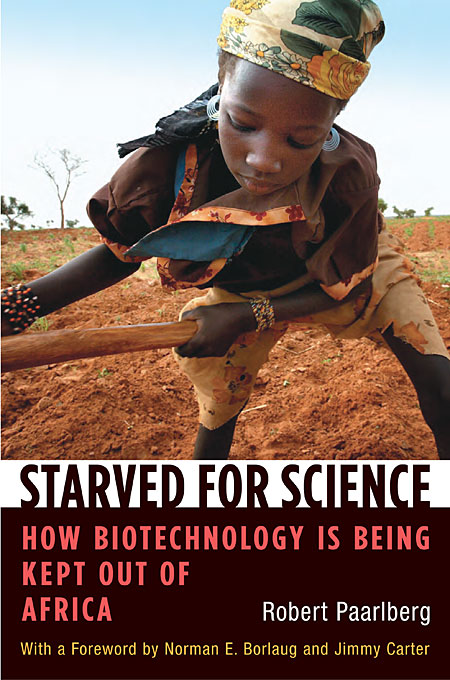
Starved For Science?

I'm reading this book:  Starved For Science: How Biotechnology is being kept out of Africa. Being that I am going to be be researching this summer in agricultural biotechnology at the Danforth Center for Plant Science, I was very interested to read it.


I've always grown up with this untraceable notion that biotechnology (Genetic Engineering, really) was bad. That it was going against God's creation, going to destroy the ecosystem and bring doom us all. Even in the first few pages of this book I have realized my opinion was naive, at least when it comes to agricultural biotechnology.

I didn't realize how many GMOs (Genetically Modified Organisms- what a scary phrase) are already being approved, grown and consumed by Americans. Yet, nothing has happened. In fact, there have been studies that have shown NO negative effects of GMOs on human health, and for as long as we've been consuming them, I trust theses studies.  For the people who are afraid it might destroy the ecosystem- it is even suggested that these GMOs may even help the environment by reducing the need for other toxic chemicals. To me- that's a good thing.

Now, I don't want to go on and on about all the things Paarlburg says in his book. I don't need to summarize it for anyone who actually reads this. But it is causing me to reflect. My speech final last year was a persuasive speech- and I gave it about genetic engineering. My argument? That it was going against God's creation, going to destroy the ecosystem and bring doom us all.  It was a pretty good speech, too. Boy, I'm starting to feel like a hypocrite. I realize now that I was mislead, under informed and accepted the majorities viewpoint.

This was the viewpoint of most Americans and Eurpeans. We're all scared of GMOs. Starved For Science has shown me that it is this uninformed fear has been keeping biotechnology and agricultural science, and therefore agricultural improvement, OUT of Africa- the place that needs it most. These technologies (not only biotechnology, but mechanical as well) helped America and Europe reach their agricultural stability. Now that we are stable, we see no benefit for GMOs, so why take the risk? (Even if there hasn't been one proven yet...) We are no longer struggling to put food on our tables, in fact, we probably have too much. Therefore, as a society, we have decided to protest genetically modified agriculture because we no longer need or notice the improvement these technologies can bring. Okay, we can be picky, we're well off enough. If we want to choose the organic pasta over the umpteen other types of pasta we are able to purchase, that's fine.  If we choose to buy the non-GMO corn over the GMO corn- more power to you!

Not the struggling farmer in Africa. The poor family who have to battle against drought and disease every year just to feed their family, let alone make a profit from it. We have the technologies to help their farms, but our fears have been cast upon these people. We decided that agricultural biotechnology was dangerous and scary, convinced the leaders of African countries of the same and have therefore barred the application of biotechnology in Africa. One leader even rejected corn aid from America because it was a GMO. African farmers do not have the access to the technologies that helped America and Europe develop to the agricultural stability they have now. Essentially, they are stuck.

I've probably lost a lot of readers, and I'm only part way through Chapter 2. This book is rocking my world, showing me that I need to reconsider by opinions and become more informed. About any opinion that I hold. I urge you to do the same. The world is a big place, and I never thought that a speech I did my freshman year of college could have an impact on the fields in Africa. Jeepers.

Wednesday, March 7, 2012

I'm entering myself into the blogosphere. I'm hoping that this will allow me to think about life more as I process everything through words.

As someone who loves to cook- this will be my outlet to save and gather what I learn in my kitchen.

As a student- this will be where I nerdily share the science tidbits I find interesting.

As a Christian- this will be where I process my growth in Christ. 

As a dreamer- this will be where I document my journey pursuing a solution to world hunger and towards a better world.

Let's see what happens.